

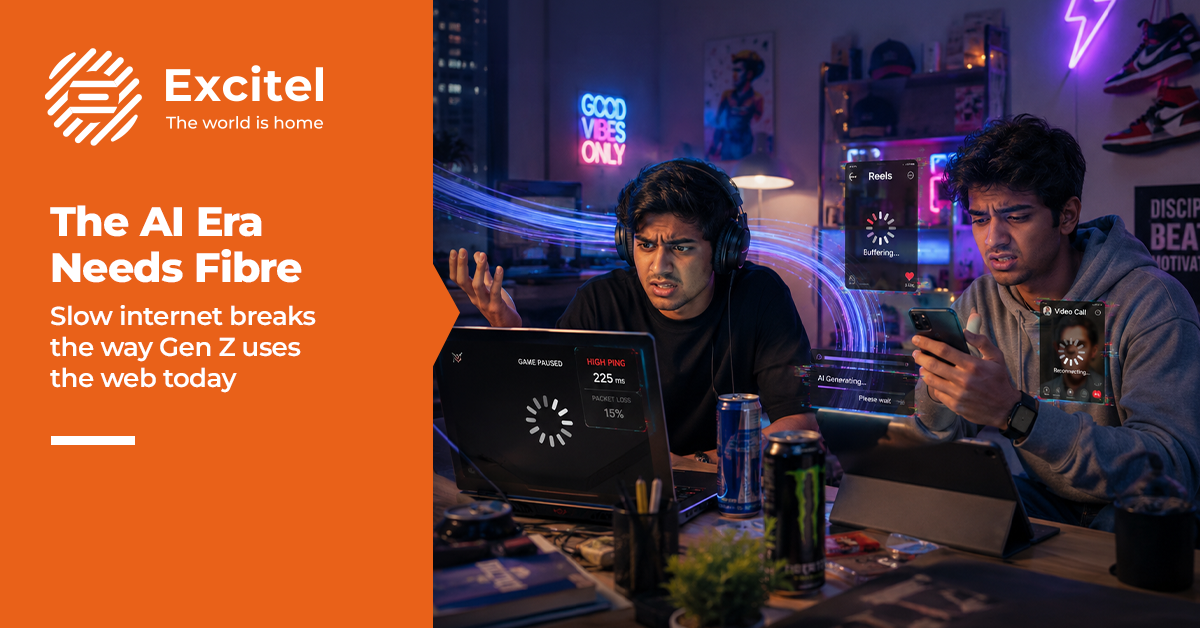


The search bar is not dead, but for a huge chunk of India’s under-25 population, it might as well be. Gen Z internet habits have fundamentally shifted. Instead of typing a query into Google and scrolling through ten blue links, they open ChatGPT, ask Perplexity, or let a YouTube Short answer it in 45 seconds.
This is not a minor behavioural tweak; it is a complete rewiring of how information gets consumed at home. And here is the problem: most home internet plans in India were never designed for this. Traditional broadband connections built for basic browsing and HD streaming are now being pushed into AI-heavy, always-on, multi-device households where the internet is genuinely working harder than ever before. If your connection keeps dropping, lagging, or slowing down at 9 pm, the issue is not your router; it is your plan.
How Gen Z Searches the Internet Differently Than Millennials?
The shift is real, and it is happening inside Indian homes right now. Here is exactly what it looks like:
- ChatGPT and Perplexity over Google: AI tools give one direct answer instead of a page of results to scroll through.
- Conversational queries: Instead of keywords, Gen Z types full questions and expects immediate, contextual responses.
- Reels and Shorts over blogs: Short-form video on Instagram and YouTube has replaced long-form reading for most topics.
- Voice assistants for everything: From setting reminders to getting recipe ideas, AI chatbots handle what search engines once did
All these habits require a fast, consistent, and genuinely available Wi-Fi connection all day. Excitel’s fiber broadband plans are built for exactly this kind of always-on, real-time browsing, not the occasional Google search.
What Internet Speed Do You Need for AI Tools at Home?
Speed alone is not the answer. Internet speed for ChatGPT and similar tools is more about stability than raw Mbps numbers.
- Stable beats fast: AI tools like ChatGPT and Gemini need a consistent connection, not one that spikes and drops.
- Upload matters too: Sending files, images, or documents to AI platforms requires solid upload speeds, not just download.
- Multi-user slowdown is real: Three family members on AI tools simultaneously can strangle a weak connection.
- Low latency is non-negotiable: Voice-based AI and real-time tools need low ping, not just high bandwidth.
Why Regular Broadband May Not Be Enough?
Most older connections were not built for the internet demands of 2025. The gap is showing.
- Cable and DSL struggle during peak hours: Congestion between 8 pm and 11 pm is a well-known problem with legacy connections.
- AI tools are bandwidth-hungry: Image generation, video AI, and cloud sync all need sustained, not burst, bandwidth.
- Fiber vs. cable is not a minor difference: Fiber broadband delivers far more reliable speeds than traditional cable infrastructure.
- Speed on paper is not real-world performance: Buffer-free streaming and fast AI response depend on network quality, not just the number your provider advertises.
How Home Internet Changed Because of AI in Two Years
The shift happened fast. Here is how different home internet usage looks compared to just two years ago:
- ChatGPT went mainstream in 2023: An average household’s data usage jumped alongside it.
- Data consumption has surged: Video calls, cloud gaming, and AI browsing have all pushed averages significantly higher.
- FUP limits are a real problem: Families now need unlimited-data broadband plans in India that do not throttle mid-session.
- Good internet means something different now: Reliability and uptime matter more than peak speed.
Best Broadband Plans for Heavy Users in 2026
Choosing the right plan in 2026 requires a different checklist than it did three years ago.
- 100 Mbps minimum: Look for plans at 100 Mbps or higher with truly unlimited data.
- Check the FUP policy: Many providers slow you down once you reach a data threshold; the best broadband in India should not.
- Fiber over everything: The best broadband for AI use runs on fiber, not cable or DSL.
- Downtime history matters: Your internet provider should have a strong uptime record and responsive support.
Excitel offers affordable broadband for heavy users across Delhi, Hyderabad, Lucknow, Rajasthan, and Uttar Pradesh, with plans ranging from 200 Mbps to 300 Mbps, unlimited data, and OTT bundles including 22+ platforms such as Amazon Prime Video, Disney+ Hotstar, and SonyLIV.
Gen Z’s internet habits have permanently changed the demands on home broadband, and the connection that cannot keep up is the one that gets replaced. Excitel’s fibre broadband gives you the speed, stability, and unlimited data that this new era of AI-driven home internet requires. Visit Excitel to find the right plan for your household today.
FAQs
What internet speed do you need to use AI tools like ChatGPT?
A stable, high-speed internet connection of 25 Mbps or more is sufficient for individual use. For households with multiple users on AI tools simultaneously, 100 Mbps fiber with low latency is the more reliable choice.
Why is my internet slow when multiple people use AI at home?
Most traditional broadband connections share bandwidth across devices; the more people using AI tools or streaming at once, the slower each connection gets. A fiber broadband plan with higher speeds solves this directly.
Best broadband plan for heavy internet users in India?
Excitel’s 300 Mbps Cable Cutter plan offers unlimited internet, 22+ OTT platforms, 250+ live TV channels, and consistent fibre speeds, making it one of the best broadband options in India for heavy household usage.
What is fiber broadband and why is it better?
Fiber internet for home uses light signals through fibre-optic cables rather than electrical signals through copper, delivering faster, more consistent speeds with lower latency and less interference than cable or DSL.
Which broadband is best for work from home and AI tools?
Look for a Wi-Fi connection on a fiber network with at least 100 Mbps, unlimited data, and low latency. Excitel’s home internet plans, available at 200-300 Mbps, are built for remote professionals and AI-heavy households.